I have now tried three methods:
- Trimmer Router with Jig
- Hand Cut with Pull Saw
- Hand Cut with Plane
Trimmer Router with Jig
Early on in my project I realized I needed to figure out how to do scarf joins as purchasing and transporting 16' or 18' long lumber for the gunwales, caps, inwales, and chine logs would be impractical. But scarfing three 6' lengths to craft the needed parts meant a minimum of 16 joins - which really means 32 cuts. I held no delusions of my ability to make that many cuts accurately by hand. I went looking for a jig for a router.
I found the plans for a relatively simple jig on Wooden Boat Forum, which resulted in this set-up:

While it took a bit of time to build the jig, I only had to do that once. Set up takes a few minutes but it is not difficult. I was quite pleased with the scarf join this set-up produced:

The drawbacks to the router jig set-up include the noise, the dust, and storage of the jig.
Hand Cut with Pull Saw
In the months since building the router jig, I have used the Japanese style pull saw more and more.
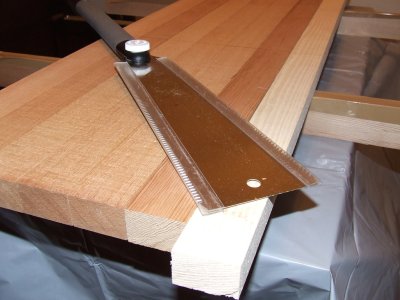
Feeling pretty confident with it, I decided to test cut a scarf join for one of the chine logs.

I was pretty please with the cut - until I dry-fit the pieces together. The mating surfaces did not match up very well at all. However, a little work with the ROS salvaged this join.
Hand Cut with a Plane
Back when I was searching for a scarfing jig, a friend expressed his preference for cutting scarfs with a plane. His method calls for clamping the stock to a solid base to minimize flex and motion and to stagger the two pieces in a stack to cut both at the same time. Way back then I did not have a solid enough base to support the stock. The Work Mate is a great portable workbench, but it is not very heavy. It does not provide the sort of solid base needed to plane scarf joins.
My recently built saw horses are heavy and solid enough.

So, I took the two pieces for the second chine log, measured and marked them, stagger-stacked them and went to work with the plane.

While I really enjoyed working with the plane to cut the join. I was not pleased with the result. The mating surfaces did not match up very well, and after quite a bit of remedial work I am tempted to set up the jig to re-cut these two pieces.
I enjoyed the process involved with using the plane. There is just something about working the wood with a plane that is very satisfying. However, that satisfaction fades away pretty quickly when the actual results are so disappointing.
I liked cutting the joins with the pull saw. But having to rework the join to get a decent fit is a bit of a let down. Now, one way to look at it is to say, the reworking is part of the process. That may be, but the re-working takes away from the utility of the method for me.
The router jig turns out to be my favored method of the three I've tried. The jig allows for repeatable and consistently accurate cuts requiring no reworking. No, the router is not as satisfying a method as the plane, but the router seems to produce the "best" results for me.
My experiences with these methods are just that - my experiences. I suspect my skills with the saw and plane will improve with practice and experience. For now, I will use the router jig for the rest of my scarf joins.


1 comment:
Your scarf is like my stem!
Post a Comment